Your Ad Here

Monday, August 11, 2008

Lack of Technological Innovators Threatens Michigan

A sharp decline in engineering-school enrollments in Michigan will have an adverse effect on the state's economy and also threatens the long-term recovery of the US domestic auto industry.

"In the past six years new engineering enrollments at Michigan universities have plummeted by more than 13 percent compared to a nine percent increase nationally," says Leo Hanifin, dean of the University of Detroit's College of Engineering and Science. "In Michigan, this precipitous drop is clearly linked to layoffs and poor performance within the domestic auto industry."

Hanifin says that the United States is facing a crisis in the development of engineering talent.

"Forty-five percent or more of all Chinese college students currently study engineering compared to just 4.5 percent in the United States," he says. "Nationally, low enrollments at engineering schools are tied to poor high-school preparation and low interest levels, especially among women and minorities."

Speaking at a major automotive conference in Traverse City on Monday, Aug. 11, Hanifin says that studies indicate that 80 percent or more of the nation's gross domestic product (GDP) comes from the introduction of new technologies, adding that "engineers are essential for
technological innovation."

He says factors that will contribute to the nation's shrinking pool of engineering talent include:

-- Massive retirements among "baby boomer" engineers,
-- A general drop in the number of college-age students,
-- Fewer foreign engineering students studying in the United States,
-- Fewer foreign students choosing to remain here after graduation, and
-- Increased global competition for technical talent.

"More and better-educated engineers are needed if our nation and its auto industry are to thrive or even survive," he says. "The problem of low engineering enrollments can only be solved by decisive action that includes changes in public policy and national programs, as well as increased collaboration within the educational community, government and the private sector."

Watch more breaking news now on our video feed:


Bookmark http://universeeverything.blogspot.com/ and drop back in sometime.

Labels: , , , , ,

Saturday, May 24, 2008

NASA Summer School Students Explore How to Protect Against Health Risks in Space Travel

Childhood dreams and mentor encouragement, paired with scientific expertise in areas ranging from biology to physics, have united an elite group of students and scientists from around the world who will participate in the fifth annual NASA Space Radiation Summer School at the U.S. Department of Energy's Brookhaven National Laboratory. The group will work in Brookhaven Lab's Medical Department and NASA Space Radiation Laboratory (NSRL) -- a unique
facility that simulates the harsh radiation environment of outer space -- to study ways to protect against possible risks astronauts may face during future long-term space flights. The three-week course will be held May 28 to June 20. Fifty-eight students have participated in the program to date.

As NASA gears up for an outpost on the Moon, plans for exploration of near-Earth asteroids, and prepares for a mission to Mars, many potential health risks to human space travelers remain unknown. It is vitally important to learn how astronauts will be affected by deep-space radiation and how to best protect them from harm. To tackle these challenges and help make space travel as safe as possible, the NASA Summer Program provides an opportunity for top graduate
students and post-doctoral fellows from various scientific backgrounds, as well as scientists trained in the discipline of space radiobiology, to work together.

"The radiation environment in space contains numerous types of charged particles of high energies, and the NSRL enables researchers to perform studies here on earth to examine the biological effects of exposure to these charged particles," says Peter Guida, Medical Department Liaison Scientist for this program at Brookhaven Lab. "This type of research is essential to help determine the possible risks that space travelers may encounter."

Fifteen graduate students, post-doctoral fellows, and working scientists, along with two auditing professionals, are participating in this year's summer school. The program has three scientific modules: physics/dosimetry (led by Lawrence Heilbronn of Lawrence Berkeley National Laboratory), cell-molecular-animal biology (led by Gregory Nelson of Loma Linda University Medical Center), and experimental methods (led by Betsy Sutherland of Brookhaven Lab). The program is sponsored by NASA and organized and managed by Brookhaven Lab, Loma Linda, and Universities Space Research Association (a consortium of universities, research
organizations, and governmental groups involved in space research).

"Our goal is to attract the highest quality students and fellows from diverse scientific backgrounds and help train them to be the next wave of space radiation researchers," says Eleanor Blakely of Lawrence Berkeley, 2008 NASA Summer School director.

The intensive, three-week course offers a unique physical and intellectual environment not duplicated in the nation's universities, medical schools, or research institutes. Students participate in both classroom activities and scientific experiments, working side-by-side with top space scientists from research organizations such as NASA, Brookhaven Lab, Lawrence Berkeley, Loma Linda University, Columbia University, University of Pennsylvania, California
Institute of Technology, University of Texas Southwestern Medical Center, and University of Maryland, Baltimore County. Experimental creativity and interdisciplinary approaches are emphasized.

Studies at NSRL simulate space radiation to learn how the intense rays may promote the development of cancer, as well as how this radiation can affect the central nervous system and other organ systems of the body. NSRL researchers are also looking at ways to protect
against these dangers through shielding and other strategies to minimize the risk to space travelers.

NSRL is a $34-million facility that was built by Brookhaven Lab with funding from NASA with the cooperation of the Office of Nuclear Physics within the U.S. Department of Energy's Office of Science. Operational since 2003, the facility is part of the lab's collider-accelerator complex, which is maintained by the DOE Office of Science's nuclear physics program and receives incremental operations and maintenance funding from NASA.

Watch more breaking news now on our video feed:


Bookmark http://universeeverything.blogspot.com/ and drop back in sometime.

Labels: , , , , ,

Tuesday, March 04, 2008

NASA Langley Encourages Student Robot Teams to Go Into 'Overdrive'

A group of teenagers is coming all the way from Hawaii to Virginia this week to demonstrate their skill with a remote control robot and some giant rubber balls.

They're one of 63 teams, mostly from Virginia and North Carolina, scheduled to compete in this year's Virginia regional FIRST Robotics competition at Virginia Commonwealth University's (VCU) Siegel Center in Richmond. The eighth annual three-day event, which is free and open to the public March 6-8, is sponsored by NASA's Langley Research Center in Hampton, Va. and VCU.

Jeff Seaton, an aerospace engineer at NASA Langley, has been involved with the regional competition for 11 years. "I started out as a team mentor and now I'm a master of ceremonies for several regional events and the championship in Atlanta," says Seaton. "The atmosphere at a FIRST Robotics competition is hard to describe. It's a combination of a rock concert and
the NCAA basketball tournament, except you have robots and it's focused on engineering."

That excitement is what inventor and founder Dean Kamen was looking for when he founded FIRST or For Inspiration and Recognition of Science and Technology in 1989. He wanted to inspire youngsters' participation in science and technology, "by creating a world where science and technology are celebrated and where young people dream of becoming science and
technology heroes," according to the FIRST Robotics website.

Participation is what the competition is all about. Working with engineering mentors, high school students had six weeks to design, build and test a robot that can meet a specific engineering challenge. Fifteen hundred teams from the U.S., Great Britain, Brazil, Canada, Chile, Mexico,
the Netherlands and Israel all picked up a common kit of parts that included motors, batteries, a control system and automation components back in January. The hitch... there are no instructions. It was up to the teams to figure out how to create a robot that could play this year's game, which is called "FIRST Overdrive."

"The students get the chance to work side by side with practicing professionals," says former team mentor Seaton. "They're also able to be part of a team that's solving a problem that looks impossible. I have repeatedly been surprised at how creative the teenagers can be and at some
of the very innovative ideas they've come up with and actually built."

For "FIRST Overdrive" the students designed their robots to race around a 27-by 54-foot carpeted track that has a center median and a six and a half foot overpass. On the overpass sit four 40-inch inflated "trackballs," two per team. The aim of the game is for each team's robots to knock down those balls, move them around the track and pass them either over or under the overpass. Teams score points for crossing the finish line as many times as possible and can get extra points for passing the balls over the overpass and putting the trackballs back on it at the end. Two alliances of three teams compete against each other during a two minute and 15 second match.

Watch more breaking news now on our video feed:


Bookmark http://universeeverything.blogspot.com/ and drop back in sometime.

Labels: , , ,

Monday, February 18, 2008

Where Will We Find The Next Generation of Engineers?

A new study that examines the number of engineering graduates coming out of our nation’s engineering schools reveals a mixed picture of how prepared each state is for meeting the need for high-tech workers in the coming years.

Greg Schuckman, assistant vice president of university relations and director of federal relations and research advancement at the University of Central Florida, authored the study after revisiting data that he had analyzed in 1998 while working for the American Association of Engineering Societies (AAES) in Washington, DC. “Over the past 20 years, the number of students earning bachelors degrees in engineering has declined by almost 3 percent nationally,” says Schuckman. “While that statistic may not seem significant by itself, the decline comes at a time when the number of students receiving bachelors degrees overall in the United States has increased by more than 50 percent.”

John Brooks Slaughter, president and CEO
of the National Action Council for Minorities in Engineering, Inc. (NACME) noted last year that, “Huge changes have occurred in our economy largely as a result of globalization and technological innovation. Manufacturing has declined while the information age requires more professional and high-tech skills from employees. It is estimated that more than a half million engineers will be needed over the next decade to replace those who retire and that at least that many new engineers will be needed to fill the demand that will exist at the end of that period. We find ourselves importing talent and exporting jobs, not just because it is less expensive to have the work performed by lower-wage skilled workers in developing countries but also because we do not produce enough native-born, well-qualified scientists and engineers in our nation’s colleges and universities.”

Overall, 20 states increased their production of engineering graduates while 30 states and the District of Columbia decreased between 1986 and 2006.

Watch more breaking news now on our video feed:


Bookmark http://universeeverything.blogspot.com/ and drop back in sometime.

Labels: , , , , ,

Sunday, October 21, 2007

An Alternative For Student Loans

Whether you're a student, recent grad, or parent, one thing from college that you likely have in common is student loans.

Maybe those loans are weighing you down. That debt may be keeping you from taking the next step in your life -- buying a car, a home, or (for parents) planning your retirement.

NextStudent.com is offering a new solution, through their Student Loan Consolidation program.

The Student Loan Consolidation bundles all of your federal student loans into one managable loan with one monthly payment, and you can lock in your payments with a fixed rate.

How much could you save? Visit the NextStudent.com website and use their online loan calculator to see how you would benefit in your particular situation.

After that, you can apply right online. See how this unique service could free you financially and unlock more of your future today.

NextStudent also offers Private Student Loans, where you can qualify for your full cost of education in as little as 15 minutes. It's another source of educational funds and it could be tax-deductable.

This post was sponsored by your friends at NextStudent.com.

Bookmark http://universeeverything.blogspot.com/ and drop back in sometime.

Labels: , , , , , ,

Monday, October 08, 2007

North Dakota Students Break Twister Record


Watch more breaking news now on our video feed:


Bookmark http://universeeverything.blogspot.com/ and drop back in sometime.

Labels: , , ,

Friday, August 17, 2007

New Initiative to Give Families Better College Information

Spurred on by the popularity of the U.S. News & World Report annual college rankings, the the National Association of Independent Colleges and Universities (NAICU) next month will launch a directory of concise, web-based, and user- friendly profiles of hundreds of private colleges and universities.

Each college and university profile will contain information on admissions, enrollment, geographic and racial/ethnic diversity, graduation rates, most popular degrees, price of attendance, financial aid, net tuition, loan debt, and much more --all in a common format, the association says.

The directory will be known as U-CAN (the University and College Accountability Network).

U-CAN is different from other college information tools inseveral ways, the association says. The type of information collected and the design of the college and university profiles were shaped by the focus groups with students and parents, it says. U-CAN collects the most useful information from participating institutions, and reports it in reader-friendly format. Reputation surveys and institutional rankings are not part of consumer-informed U-CAN website, it adds.

Participating schools include Ivy League universities, liberal arts colleges, historically black institutions, women's colleges, religious and faith-related schools, and many other types of nonprofit, private institutions. The roster of institutions is quickly approaching 400, the association reports.

U-CAN will be free -- both to consumers and to the colleges and universities that choose to participate. U-CAN is not-for-profit and accepts no advertising or sponsorships, the association adds.

Watch breaking news now on our video feed:


Bookmark http://universeeverything.blogspot.com/ and drop back in sometime.

Labels: , , , , , , ,

Tuesday, August 07, 2007

Video: Students Spend Summer Restoring Landmarks

Sitting on the edge of America's West Coast is Mount Rainier. But the snow covered landmark needs a little help. Last fall, mudslides and torrential rain caused considerable damage to trails and pathways up the mountain. Trees came crashing down, roadways were washed away and parts of the mountain were left in shambles.

This summer, a group of teenaged volunteers from all over the country is spending their vacation cutting roots, moving rocks, putting in water bars and redefining the trails that were completely lost, through a program called "Save the Trails." Funded by a grant in excess of a quarter million dollars, it allows the students to spend long days in the great outdoors learning new skills and making new friends.

By the end of the summer, they will have restored 120 miles of trail in 14 parks across the country, including the damage that was done at Mount Rainer.

Watch the video now:


Watch more news on our video feed now:


Bookmark http://universeeverything.blogspot.com/ and drop back in sometime.

Labels: , , , , ,

Tuesday, April 24, 2007

FM-Based Digital Alerting Available for Universities


A company is touting a unversity emergency-alerting system that may help prevent repeats of the murderous Virginia Tech shootings.

Global Security Systems (GSS) of Jackson, Miss., is now able to deliver the ALERT FM system to universities and colleges.

Virginia Tech student Seung-Hui Cho's campus rampage left more than 30 dead before he turned his gun on himself. The gunman began his massacre in one campus building before breaking to send materials to NBC news and then returning to his killing spree. Some have said the campus should have had more warnings sooner after the initial killings.

ALERT FM is a personal alert messaging system that enables campus administrators, emergency management personnel or police to create and send notifications to students, staff, first responders or citizens, GSS says. The FM signal offers a unique advantage in that it has coverage for areas where cell signals may not operate, also in the case of a wider emergency a carrier signal can become overloaded and delayed or cease to operate. Additionally, there are no costs associated with message delivery, the company says.

Students and staff can receive alerts via ALERT FM receivers or USB sticks, as well as mobile devices equipped with a standard FM chip. By utilizing ALERT FM, campus security would have the ability to distribute real-time notifications for emergency situations, weather warnings, homeland security notices and evacuation instructions, according to GSS.

Many universities have a licensed FM station on campus or a commercial station serving the area. The alert messaging is delivered via a secure, private digital network, which utilizes existing FM standards and transmitters, GSS says. This system uses a standard FM commercial receiver chip inserted into an ALERT FM receiver or any mobile communication device. It provides mass distribution of emergency alert messages via a local radio station's FM infrastructure.


Bookmark http://universeeverything.blogspot.com/ and drop back in sometime.

Labels: , , , , , , , , ,

Thursday, March 29, 2007

Getting a Feel for the Nano World


When it comes to research at the nanoscale, vision is not necessarily an advantage. The subjects are so small, no one can see them. To encourage people with visual impairments to pursue fields in nanotechnology, educators have developed a way to craft accurate, detailed and touch-friendly models of nanoscale objects like carbon nanofibers, allowing the students to "see" those objects for the first time.

While students have learned from abstract models of chemical structures for decades, the new technique creates 3-D versions of objects as they actually are.

Developed by educators at the University of Wisconsin-Madison (UW-Madison), the models are about the size of a textbook and are formed using rapid prototyping, a process that "prints" 3-D objects. Each model is a scaled-up replica of tweaked data from a scanning electron microscope. The creators hope they will soon be able to apply the same process to data from other instruments, including the patterns of atoms revealed by atomic force microscopes.

The approach was conceived by Andrew Greenberg, education and outreach coordinator for the National Science Foundation (NSF) Nanoscale Science and Engineering Center on Templated Synthesis and Assembly at the Nanoscale at UW-Madison and for the university's Institute for Chemical Education. He thought of the idea during a visit to the Indiana School for the Blind, which uses 3-D models of chemical structures in the classroom.

Greenberg partnered with two collaborators from the university's Center for Biology Education: undergraduate biochemistry student Mohammed Farhoud, who is skilled with the rapid-prototyping equipment, and the center director, David Nelson.

On March 27, Greenberg and Farhoud presented their novel approach at the 233rd National Meeting of the American Chemical Society.


Bookmark http://universeeverything.blogspot.com/ and drop back in sometime.

Labels: , , , , , , , , , ,

Friday, January 12, 2007

NASA GeneSat Shows Small Satellites Can Deliver Big Science


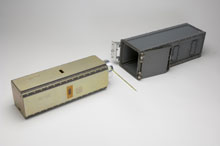
A very small NASA satellite has proven that scientists can quickly design and launch a new class of inexpensive spacecraft -- and conduct significant science. The 11-pound GeneSat-1, carrying bacteria inside a miniature laboratory, was launched on Dec. 16, 2006. It was a secondary payload on an Air Force four-stage Minotaur 1 rocket that delivered the Air Force TacSat 2 satellite to orbit.

GeneSat-1 began to transmit data on its first pass over the mission's California ground station. Scientists still receive data from the satellite regularly.

"GeneSat proves that big science can be done using small satellites," says GeneSat project manager John Hines, an engineer and scientist at NASA Ames Research Center, Moffett Field, Calif. "GeneSat's success points out how NASA can spend less money and time to learn new things in space."

According to Hines, GeneSat-1 is NASA's first fully automated, self-contained biological spaceflight experiment on a satellite of its size. "Based on this success, we expect that in the near future, this class of small satellite will see increasing acceptance and usage by the science community," Hines notes.

These small satellites will help scientists understand the hazards and risks associated with human space travel, Hines believes.

The cost to develop the GeneSat satellite class, launch the first spacecraft and operate it was a fraction of what it normally costs to conduct a mission in space, according to scientists.

Subsequent GeneSat-class missions will cost much less, Hines predicts. Researchers say that knowledge gained from GeneSat-1 will help scientists understand how spaceflight affects the human body. GeneSat-1's onboard micro-laboratory includes sensors and optical systems that can detect proteins that are the products of specific genetic activity.

Biological data returned so far have exceeded the project’s pre-launch success criteria, according to GeneSat-1 lead biologist Macarena Parra. "Throughout the experiment, the temperature remained constant and all systems functioned properly to record our required data," Parra says.
Researchers will further analyze GeneSat-1's on-board systems during the remaining life of the satellite, according to Bruce Yost, the GeneSat-1 mission manager.“We plan to conduct a number of engineering tests and evaluations to increase our confidence in the GeneSat platform," Yost says. "In the next few weeks, we will hand over the GeneSat-1 spacecraft to Santa Clara University, Santa Clara, Calif., for use as a training tool for future aerospace engineers.”

GeneSat-1 will reenter the Earth’s atmosphere and burn up before the end of the year. "Our partnership with the Santa Clara University mission operations team has surpassed all of our expectations with their level of performance and professionalism," Hines says. "This is the first NASA mission to be operated by a student-based team; they worked around the clock and over a holiday break to complete our primary mission. It was a remarkable success," Hines adds.


Bookmark http://universeeverything.blogspot.com/ and drop back in sometime.


Enter your Email


Preview Powered by FeedBlitz


Digg!

Labels: , , , , ,

Saturday, December 02, 2006

Study: Students Displaced by Katrina Suffer


Many of the approximately 200,000 Louisiana students displaced from their public schools by Hurricanes Katrina and Rita may experience long-term academic problems, according to a RAND Corporation study.

The vast majority of the displaced students missed weeks or more of school due to the storms, and most did not return to their original schools by the end of the 2005-06 school year, according to the report prepared by RAND Education for the RAND Gulf States Policy Institute (RGSPI).

“Many children relocated to other schools or left the Louisiana public school system entirely,” says lead study author John Pane of RAND. “Most students missed a lot of school and many had to adjust to new environments, which might slow their academic progress.”

Moving children among schools has been associated with detrimental effects on academic achievement both for the students who move and for other students in the schools, Pane said. In addition to missing some time in school, the students who move may find themselves inadequately prepared for their new classes because the curriculum varies across schools. These problems are compounded by the need to adjust to new social environments and overcome the trauma of the disasters.

Using Louisiana's Student Information System and a survey of 415 school principals, researchers determined that more than a quarter of the state's 740,000 public school students were displaced by one of the hurricanes – the largest displacement of students in U.S. history.

Overall, more than 81 percent of the displaced Louisiana students came from one of three parishes: Orleans, Jefferson and Calcasieu.

The study found that 45 percent of displaced students eventually returned to their original schools, either directly or after enrolling elsewhere temporarily. Another 24 percent, who did not return to their original schools, enrolled elsewhere in the state.

“After their initial re-enrollment, many displaced students continued to change schools, and a substantial number left the state's public education system entirely,” says RAND researcher Dan McCaffrey, a co-author of the report. He said the median amount of time the affected students missed from school was five weeks.

In addition, minority students and those who had been faring poorly academically before the storms were disproportionately impacted, according to the study.

Researchers found that nearly 65 percent of the displaced students were members of minority groups. About 58 percent were black, 4 percent Hispanic, 3 percent Asian and less than 1 percent Native American. This compares to the 52 percent of all Louisiana public school students who are minorities.

Researchers said some students also experienced mental health and behavior problems due to the trauma that many youngsters experienced in the storms and their aftermath, including moving to new communities and schools.

The study by RAND, a nonprofit research organization, found that the majority of principals surveyed indicated that the social behaviors of most displaced students were similar to those of students in the schools before the hurricanes hit.

But in a sizable portion of schools — particularly those serving a large number of displaced students — principals said they observed an increased level of student absenteeism, fights, verbal abuse of teachers, bullying, cutting class and theft. Displaced students were more likely to violate school rules, isolate themselves, and not participate in social activities like clubs or sports. They were also more likely to need mental health counseling.

Faculty members in Louisiana schools also experienced higher levels of work stress, job frustration and absenteeism, the study found. This resulted from the storms' effects on their own lives, as well as staffing shortfalls and strains on other key resources.

According to the report, class sizes increased in more than a third of the schools, and more than half of the schools needed more classroom teachers, special education teachers, support staff and counselors.

The study says problems that students and faculty faced during the 2005-06 school year are likely to persist. It recommends that schools continue helping students affected by the hurricanes with counseling and academic services, and also help teachers deal with their own hurricane-related problems.

“The plight of children in the face of tragedy is always a concern,” says Mike Ward, associate professor of educational leadership at the University of Southern Mississippi. “The report offers very useful insights into the experiences of students in the wake of these storms, along with recommendations to help reduce their suffering and that of students in subsequent disasters.”

Researchers found that about 53,000 of the displaced students never re-enrolled in Louisiana public schools, and another 10,000 dropped out by the end of the 2005-06 school year.

While many of these students enrolled in schools in other states, the lack of definitive tracking data makes it hard to determine where many went. Some students may not have gone back to school anywhere, losing nearly an entire year of schooling or dropping out of school.

The study says better state and national student information systems could help keep track of students who are displaced by future disasters, while also assisting in information sharing about proper placement and needed educational services, grade completion, test scores and other educational matters.

Labels: , , , , , ,